About this card
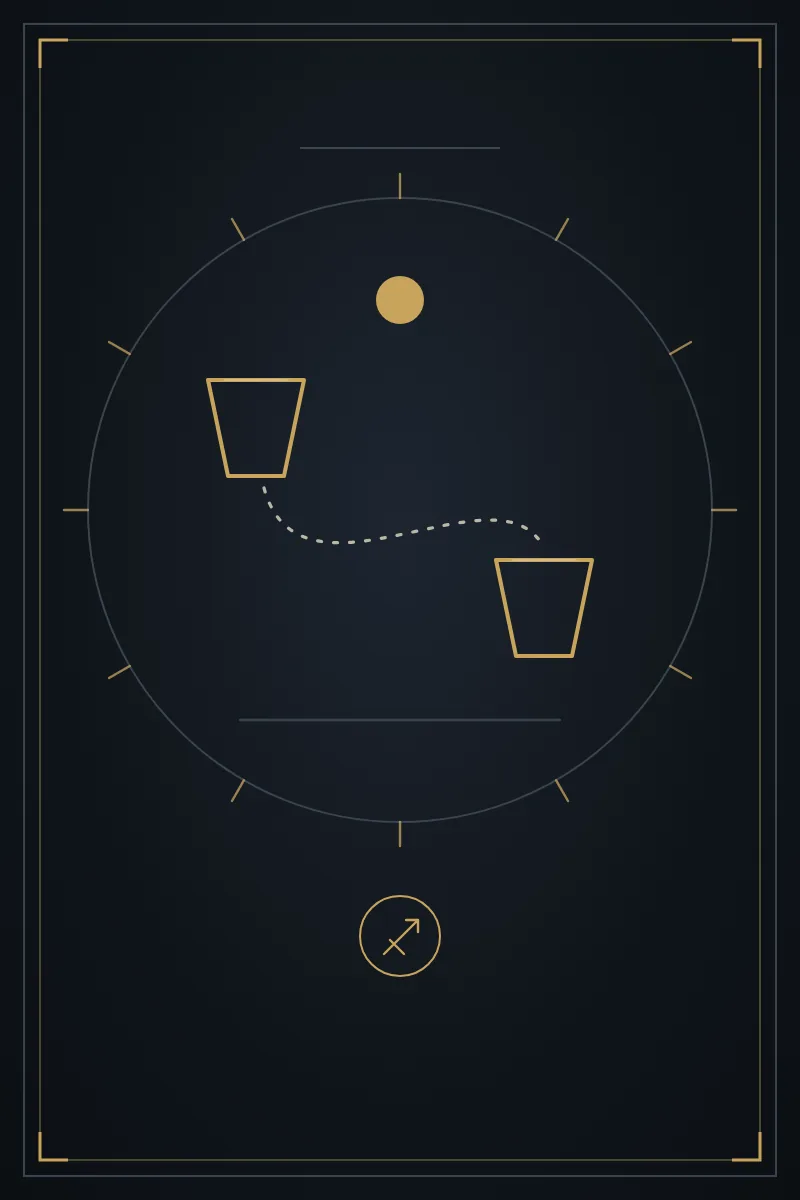
Temperance, the fourteenth card of the Major Arcana, pictures balance reached patiently, one step at a time. An angel with wide wings stands with one foot in water and one on land, pouring a stream from one cup into another, the liquid arcing through the air against gravity. There is no haste in the scene and no harsh contrast. This is the card of blending, soothing and uniting what seems at odds into a fresh whole. It appears when life asks for calm wisdom instead of extremes. In a spread it reminds you that the best results often form quietly, in the right proportions and at the right time.
Upright meaning — expanded
Upright, Temperance marks a period of harmony in which different areas of life begin to work together. Work, rest, relationships and your own needs finally find a shared rhythm. The card encourages you to seek the middle, not a compromise made out of pressure but one that grows from understanding that each ingredient has value. Gradualness is the key: changes made slowly take hold more firmly than sudden revolutions. Temperance is also a symbol of healing, both of the body and of emotions, and of patient work on yourself. It shows a person who can listen to differing voices and combine them into a coherent reply. If you have been through a hard stretch, the card promises balance returning. Note that the angel spills not a drop: precision and attention are a form of care here.
Reversed meaning — expanded
Reversed, Temperance describes proportions thrown off. You give too much or too little: of work, rest, attention to others or to yourself. A tendency towards extremes appears, all or nothing, and resilience to stress falls. It can also be impatience, an attempt to speed up a process that needs time, or a conflict between two parts of you that cannot agree. The card does not criticise but points to the place where it is worth finding your measure again. Review sleep, food, your calendar and your boundaries. Sometimes dropping one commitment or adding one regular break changes how the whole day feels. A reversed card may also invite an honest talk about mismatched expectations.
Love — deeper
In love, Temperance describes a relationship that blossoms when each person keeps their own space while sharing themselves. Compromise and a kind tone create an atmosphere where hard subjects are easier to raise. It is a good card for maturing partnerships, for couples reconciling different lifestyles, and for people learning to voice needs without attacking. It also helps in healing old wounds: closeness grows at a pace both can bear. For singles it suggests a meeting that unfolds calmly, without sudden spikes of emotion. Reversed, it points to an imbalance between giving and taking, or to an intensity that burns out. Slowing down and agreeing shared rules then helps.
Work — deeper
At work the card favours cooperation, combining different skills and spreading effort evenly. Avoid extremes, because steady moderate effort yields better results than bursts followed by burnout. It is a good moment for mediation, negotiation and projects that require fitting together different viewpoints. It suits helping professions, education, medicine and anywhere patience counts. The card also suggests pairing planning with flexibility. Reversed, it signals overload, an uneven split of duties or a missing shared vision in the team. Set priorities and protect a work rhythm that leaves room for recovery. Do not try to fix everything at once.
Advice — deeper
The advice of Temperance is: dose it. Choose one area where you feel excess or shortage and change it by a tenth, not by half. Write down what a typical day looks like and mark the moments you overdo. Introduce one simple ritual of regularity, such as a fixed bedtime or a short walk. In conversations look for common ground before debating differences. Remember that patience is not passive; it is active attention to proportion. Enjoy small progress and do not judge yourself for wobbling.
Image symbolism
The angel of Temperance joins heaven and earth: one foot rests in water, a symbol of the unconscious, the other on land, the conscious world. Two cups with water flowing between them signify exchange between inner and outer. On the angel's chest is a triangle inside a square, spirit within matter. The wings signal a link to higher wisdom, and the irises in the background recall Iris, the Greek goddess of the rainbow and messenger. A path winding towards a crown on the horizon suggests a long road to fulfilment. The card is tied to fire in some traditions and, in astrology, to Sagittarius, which adds a dimension of seeking meaning. The number fourteen reduces to five, the number of change and learning.
Frequently asked questions
- What does Temperance mean in tarot in general?
- Balance, patience and the blending of different elements into a harmonious whole. The card encourages you to avoid extremes and to introduce change gradually.
- Is Temperance a good card in love?
- Yes, it usually promises a calm, mature growth of the relationship in which both people look after themselves and the shared space. It points to compromise and a kind tone in talks.
- How should I read reversed Temperance?
- As proportions thrown off: overload, extremes, lack of rhythm or impatience. It is a signal to find your measure again and give yourself more recovery.
- Why does the angel stand with one foot in the water?
- Water symbolises the unconscious and emotions, land the conscious mind. The angel joins both worlds, which means agreement between intuition and reason.